 gyankalakumbhKNOWLEDGE. ART. POSSIBILITY.
Big discoveriesbegin with “why?”
A leaf. A torch. A folded piece of paper. Ordinary things hold extraordinary questions. Come, look at the world like a scientist.
Make your first discovery Find an activity for your class ↓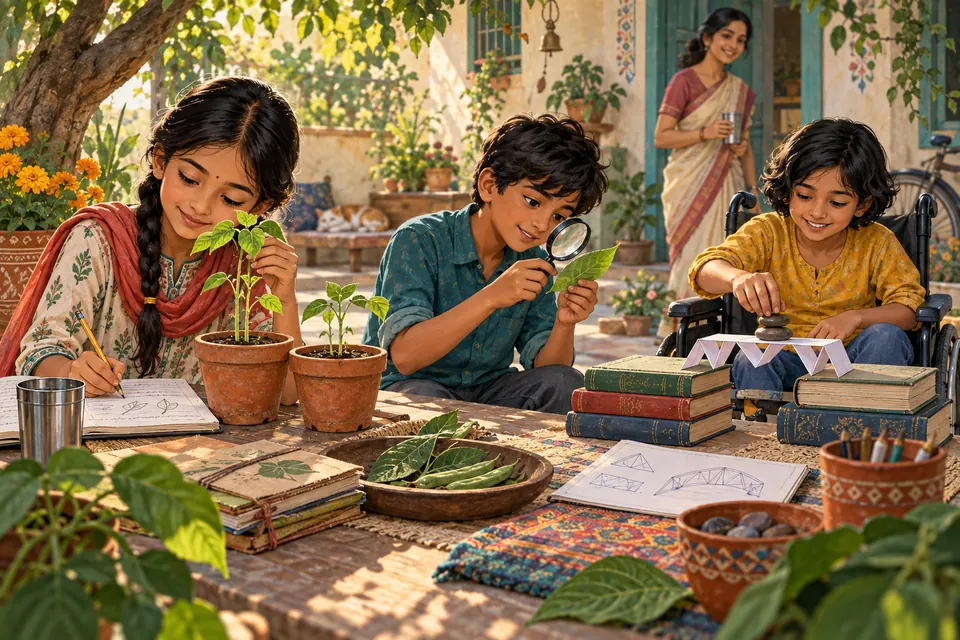
“How do we know?”
A surprising result is an invitation to look again. These steps can help; real investigations often loop back or begin with observation.
- 01Look closely
- 02Make a prediction
- 03Try & compare
- 04Record what happened
- 05Rethink your idea
Your discovery desk
No timer. No marks. Make a prediction, then investigate.
Opening your discovery desk…
Small missions. Fresh eyes.
Speak, draw or write. Work at your pace, with help from a trusted adult.
8 missions to explore
 Classes 1–3
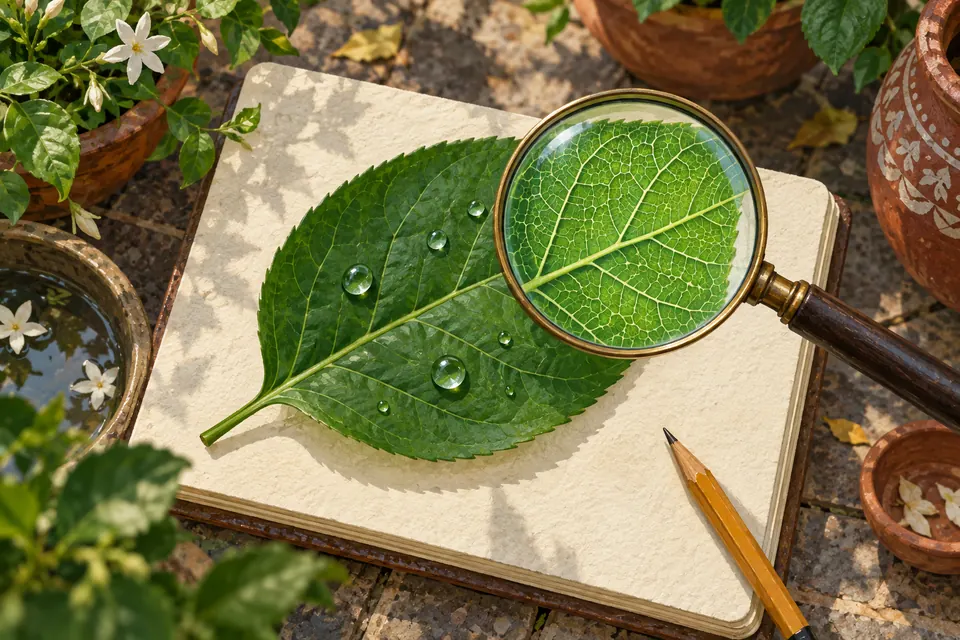
A whole map inside a leaf?
Look at a fallen leaf. How many things can you notice before you name it?
Open your mission
Your question
Do all leaves have the same pattern of veins?
What you need
Two fallen leaves, paper and a crayon. Ask an adult to choose safe, familiar leaves.
- Look closely. Draw the outline and the lines you can actually see.
- Put each leaf under paper and rub gently with a crayon. Compare the two rubbings.
- Name one similarity, one difference and one thing you still wonder about.
Two leaves are two examples, not every leaf in the world. What would you look at next?
Describe your discovery aloud or draw it. You do not have to write long answers.
Background reading: NCERT · Textbook library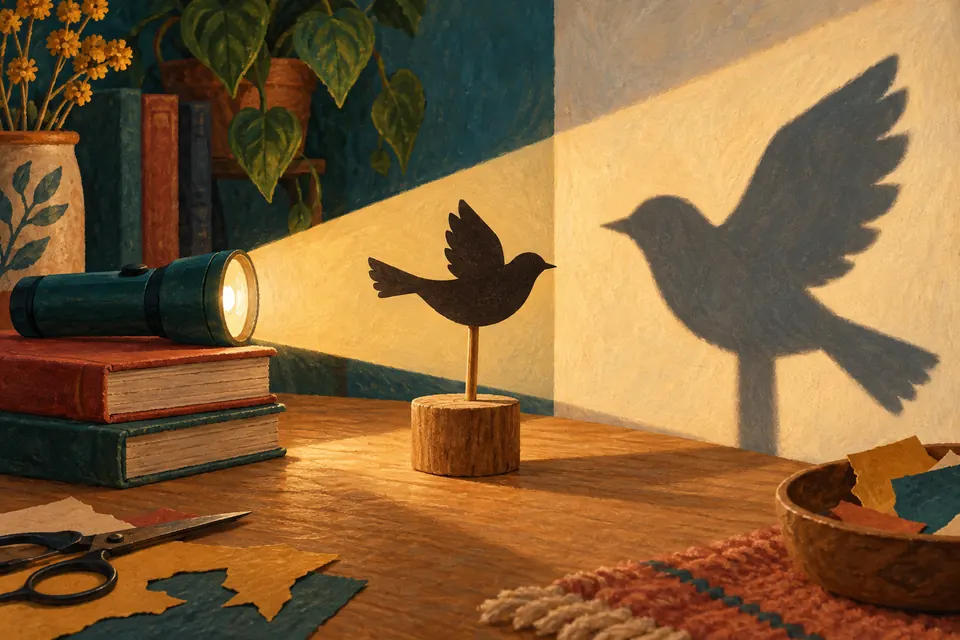 Classes 1–3
Can a tiny bird make a giant shadow?
The paper bird stays the same. Its shadow can tell a different story.
Open your mission
Your question
What changes when the object moves nearer to the torch?
What you need
A battery torch, a wall and an opaque toy. Work with an adult; keep light away from eyes.
- Keep the torch and wall still. Make a prediction before moving the toy.
- Move only the toy nearer to the torch. Compare the shadow with its earlier size.
- Move it back. Does the earlier shadow return? Draw both positions.
If the torch moves too, can you still tell what caused the change?
Try the screen model below first, then compare it with the real torch.
Background reading: NCERT · Textbook library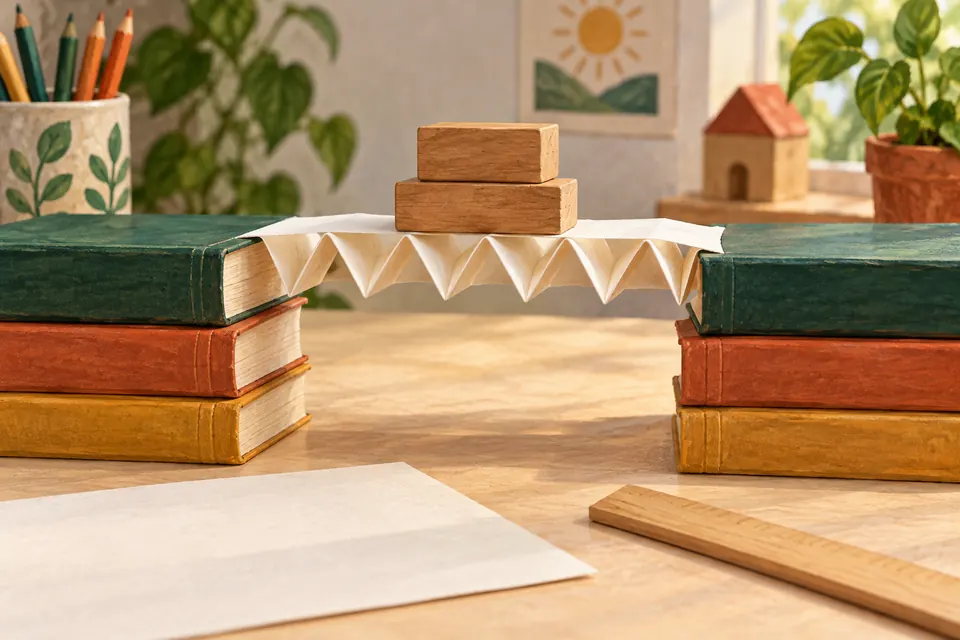 Classes 4–5
Can a fold make paper stronger?
Same paper. Same gap. A different shape. Put your idea to the test.
Open your mission
Your question
Which shape carries more of the same light blocks: flat or folded paper?
What you need
Two equal sheets, two low stacks of books and identical lightweight toy blocks. An adult can help fold.
- Keep the book stacks the same height and the gap unchanged. Place a flat sheet across them.
- Add identical light blocks at the centre, one at a time. Stop when the paper bends too far; note your stopping rule.
- Try the equally sized folded sheet. Repeat with fresh sheets and the same stopping rule.
A bigger sheet would change two things at once. How will you keep the comparison fair?
Keep every result, including the trial that surprised you. Explain why repeated trials may differ.
Background reading: Science Buddies · Asking questions and testing ideasClasses 4–5A pattern—or a lucky guess?
Three similar leaves are a clue. Let the fourth one challenge your idea.
Open your mission
Your question
Can the features of a leaf help you match it to a familiar plant?
What you need
Drawings or safe fallen leaves from two familiar plants, selected with an adult.
- Compare shape, edges and vein patterns. Use more than colour alone.
- Ask an adult to show another leaf without telling you its plant. Predict its match.
- Check the plant it came from. Note which clue helped and which did not.
An identification can be uncertain. More observations can help you revise it.
Never taste unknown leaves or use this activity to decide whether a plant is edible.
Background reading: NCERT · Textbook libraryClasses 6–8Was sunlight really the reason?
One plant grew more. Before you explain it, investigate how the comparison was made.
Open your mission
Your question
What must stay similar when we investigate the effect of light on plants?
What you need
Paper and a plan. This first activity designs a fair test; no plant needs to be kept in darkness.
- List light as the condition you want to change. List water, soil, plant type and age, pot size and temperature separately.
- Explain how you would keep the other conditions similar and measure growth at the same times.
- Plan several plants in each condition. Ask a teacher to review the plan before a real investigation.
A good design makes evidence more useful. It does not give you the result before you collect it.
Light can change temperature too. How might you measure or reduce that extra difference?
Background reading: Science Buddies · Asking questions and testing ideasClasses 6–8One result is only the beginning.
2, 3, 2. And 6, 5, 7. What can repeated measurements tell you?
Open your mission
Your question
How do we compare results when repeated trials are not identical?
What you need
The clearly labelled example results in the paper-bridge screen activity and a notebook.
- Write all three example values for each paper shape. These are authored data for practice, not real measurements.
- Calculate each mean and range. Keep the individual values visible too.
- Write a conclusion limited to these example results. Name one possible source of variation in a real test.
Averages help summarise. They do not replace the conditions, sample size or raw observations.
What if one paper sheet was already creased? How would you record that instead of silently deleting the result?
Background reading: Science Buddies · Asking questions and testing ideasClasses 9–12When does a model stop matching reality?
A perfect point of light predicts a sharp shadow. A real torch can add a fuzzy edge.
Open your mission
Your question
Which assumptions make the screen shadow model work?
What you need
The shadow model, paper and a ruler. For a real comparison, use an adult-assisted battery torch away from eyes.
- Use the model’s point source, 10 cm object and fixed screen at 120 cm. Record two object distances.
- Use similar triangles: shadow height / object height = source-to-screen distance / source-to-object distance.
- List what a real torch changes: source size, alignment, measuring error and ambient light.
A mismatch can reveal a missing assumption. It is a reason to refine the model and test again.
Measure from the light source, not from the front edge of the torch’s casing. Explain why the reference point matters.
Background reading: NCERT · Textbook libraryClasses 9–12Some discoveries take patience.
You cannot move the Moon for an experiment. You can make careful, dated observations.
Open your mission
Your question
How does the Moon’s visible lit shape change over several evenings?
What you need
A notebook and a safe view with a trusted adult. No telescope, roof climbing or direct Sun observation.
- On evenings when the Moon is visible, record date, time, weather and a sketch. Record ‘not seen’ when appropriate.
- Compare several observations with NASA’s phase explanation. The Moon is not visible at the same evening time every day.
- Explain which changes are in the illuminated portion we see, rather than the Moon changing its physical shape.
Clouds and a missing observation are gaps in evidence. Do not draw invented observations to fill them.
Science includes observation as well as experiments. Which questions can you study without controlling the object?
Background reading: NASA · Moon phasesLeave room for “I am not sure yet.”
Ask “What did you notice?” before “What is the answer?” Let children disagree respectfully, keep unexpected readings and explain what evidence might change their minds.
A good answer often opens a better question.
Try the practice quizzes